1,000 words, image seven

8 02 2012

(Seventh in a series of eventually 1,000 images).

This artist’s work is world famous and has been seen in museums, gardens, office buildings, and even a certain Las Vegas casinos. Do you recognize it?

Venetian gondola


Dale Chihuly’s glasswork is distinct and instantly recognizable when you see it – even if you don’t know the artist by name. This is a piece inspired by a Venetian gondola and was part of an exhibit at the Boston Museum of Fine Arts in 2011.

Chihuly’s work is known for bold colors and evocative recreations of nature’s own handiwork, and it is inspiring and accessible to those who see it. Displays may be viewed publicly in places such as Bellagio in Las Vegas or the San Antonio Public Library, or at exhibits throughout the United States and world. To find information about public installations and upcoming exhibitions, visit chihuly.com.


Veteran’s Day is a day to honor, remember, and give thanks

11 11 2011

On the eleventh hour of the eleventh day of the eleventh month in 1918, the “war to end all wars” – World War I – ended. A year later, President Wilson issued a proclamation recognizing Armistice Day as a day of remembrance and honor for those who died in the name of service to the United States. Thus, the beginning of what is now known as Veteran’s Day in the United States and is still remembered as Armistice Day throughout the world.

Although the day began as a way to honor the fallen of World War I, in 1954 the official U.S. holiday became known as Veteran’s Day in recognition of World War II and the number of military personnel who served during that war. Veteran’s Day became a holiday that honors the service of all veterans of war of the soldiers who fought in World War II and to recognize all members of the armed forces who served in war. Unlike other federal holidays that are tied to the closest Monday, Veteran’s Day is always observed on November 11 to preserve the historical significance of the date and to acknowledge the men and women who fought, and often died, in service of the United States of America.

Throughout the world, particularly in Great Britain, France, Belgium, Australia, and New Zealand, the day is observed as Remembrance Day with moments of silence, laying of wreaths at memorials and cemeteries, parades and other tributes to veterans of all wars. The red poppy flower is commonly worn as in memory and honor of war dead. According to www.greatwar.co.uk, the flower was common around the battlefields of Flanders in Belgium, Gallipoli in Turkey, and elsewhere, so it came to symbolize the life that sprang forth from these places of death of destruction after war’s end.

Communities large and small recognize Veteran’s Day, making it very easy to participate in the holiday. Visit a military cemetery, attend a local remembrance ceremony, participate in a tribute, or spend time with a veteran and tell him or her how much you appreciate their service.

This slideshow requires JavaScript.


1,000 words, image six

8 11 2011

(Sixth in a series of eventually 1,000 images).

Like death and taxes, progress happens no matter what we do to stop it. The image below may cause you to reflect on an era once considered a golden age. Do you know what it is?

Eureka Springs, AR

This is a photo of an early 20th century locomotive’s wheel and the gear which drives it. During this era, railroads were a primary method of moving goods and people throughout the United States. Today, railroads carry commodities over more than 100,000 miles of track* with passenger travel concentrated mostly in the Northeast.

Railroad museums throughout the United States are dedicated to the preservation of the history of railroads and rail travel. This photograph was taken at the Eureka Springs & North Arkansas Railway depot in Eureka Springs, AR. The railway is a living museum that tells the history of rail travel in the region, which began in the late 19th Century. ES&NA Railway offers scenic tours as well as lunch & dinner excursions.

To plan a visit to a railroad museum, visit ES&NA’s website or www.railroadmuseums.com for a directory of locations across North America.

*Source: Association of American Railroads


Cemeteries are places to honor loved ones, learn history, and celebrate life

31 10 2011

Cemeteries range from small, simple church yards with little adornments to well-manicured & perfectly symmetrical national military sites to elaborately outfitted and whimsically-designed Victorian affairs. In Macon, GA, the city’s historic Riverside Cemetery is an example of an elaborate affair where life is meant to be enjoyed. The 125-acre park on the banks of the Ocmulgee River is the ideal setting for a walking tour of Macon’s history and even a peaceful picnic under the shade of a large tree.
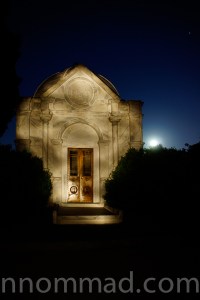
Macon, GA

The full moon peeks over distant trees to the right of a family mausoleum

Home to nearly 18,000 residents – 77 of whom are buried standing up – the grounds of Riverside Cemetery were designed by Calvert Vaux, architect of New York City’s Central Park. The private cemetery was established in 1887 and was intended to be a place full of life as opposed to the more common burying grounds of 19th-Century America. The cemetery is designed as a park, with gardens, rolling hills, and magnificent views. The monuments, markers, and mausoleums throughout are architectural & design masterpieces that provide context and information for visitors.

At the main gatehouse, an original half-timber structure, maps may be obtained and cars parked; the grounds are best explored on foot. An extraordinary tale is that of Hugh Smalling (#69, 1919-1943). Smalling was a World War II hero who died when the U.S.S. Nausett was struck by enemy fire off the coast of Italy. His brother dreamed of the ship’s sinking that night and woke his fellow soldiers in the German countryside by screaming, “Swim, Hugh, swim.” Smalling’s body was never found.

Areas of special interest include Babyland, which was established in the 1950s, and Educators’ Row, where many professors and college presidents are buried. Other affiliated groups are represented as well, commonly by special symbols or architectural elements; the markers of the 76 Woodmen of the World buried here are unmistakable for their tree trunk-like form.

A number of structures dot the cemetery and occupy prominent places on its grounds. The Macon Public Mausoleum is the largest with 300 crypts. It sits at one of the highest points in the park and is often home to special events and activities. Near the Ocmulgee River sits Pine Fort, a Confederate redoubt during the Civil War and place where troops once waited for General Sherman on his famous “March to the Sea.”

Riverside Cemetery’s landscaping includes many specimens of trees and flowers, many of which are unique to Middle Georgia. The giant arborvitaes planted throughout were once common features in cemeteries since their name means “trees of life.” Trees from Central Park and places such as Newton, Massachusetts, were part of the landscaping scheme. Flowers such as rose, daffodil, and magnolia are a few of the many species planted here.

The cemetery is operated by a private, not-for-profit corporation. The non-profit Historic Riverside Cemetery Conservancy is the public relations and preservation arm of the cemetery. The grounds are open for public enjoyment year-round, and many events are held on its grounds. A unique night-time photography session, Full Moon Euphoria, is a popular spring activity as is the cemetery’s Spirits in October tour and activity series in the fall.

Across the United States, many cemeteries offer historic tours and events to connect residents and visitors to local history. To find information about a historic cemetery in your area, search for “historic cemetery (city name)” or the city’s visitor’s information bureau.



Learn how the Fed works by visiting a money museum

15 08 2011

The Federal Reserve – aka the Fed – is the central bank of the United States. Established by Congress in 1913, the Fed is responsible for the stability of the nation’s banking system; managing monetary policy with an eye toward a sound & stable U.S. economy; and providing services to the U.S. government and financial institutions, such as check & electronic payment processing. At times, it may seem the Fed is acting in strange & mysterious ways, but much of its practices and the methods by which it conducts its business is quite open and readily accessible in the form of visitor’s centers and online information.

Atlanta, GA

The bronze eagle sculpture outside the visitor's entrance to the Atlanta Fed weighs more than 2,800 pounds

There are 12 Federal Reserve banks and 24 bank branches in the United States. Many of the banks and branches have visitor’s centers with informative money museums inside. The museums’ exhibits range from displays of older forms of money no longer in circulation to interactive multimedia displays which allow visitors to test their own skills at managing monetary policy. Exhibits also provide a history of banking in the United States covering topics such as the country’s earliest experiences with private banks that issued their own currency or how the Federal Reserve influenced & managed policies during the Great Depression of the early 20th century.

To help visitors understand the business of the Fed and its impact on everyday lives, displays cover topics such as inflation’s impact on prices and the economics of supply & demand. The centers also explain the face of the Fed – its Board of Governors – and each banks’ Board of Directors as well as what the Federal Open Market Committee is and how it operates. A favorite exhibit at each museum is seeing millions of dollars of currency on display, being moved by robotic forklifts, or physically sitting in the bank’s vaults.

The Federal Reserve Bank’s money museums are free – taxpayer money at work – and generally open during normal business hours. Group tours are generally available with advance reservations, and visits by scholars studying economics & finance may be possible, too. For school groups, banks may offer special tours to satisfy curriculum requirements and study publications may be available. The Chicago and Richmond Federal Reserve banks operate virtual money museums online.

When visiting a Federal Reserve bank, ask if they are giving away any money today: You might be rewarded with a bag of shredded currency no longer in circulation.